Oversize a solar system and you overpay for capacity you never use. Undersize it and the inverter trips when the ACs kick in, or the battery is flat by 2am. Getting the size right is the whole game, and in Lagos it comes down to three numbers.
The three numbers that matter
- Inverter (kVA): how much you can run at the same moment. Exceed it and the system trips. This is your peak power.
- Panels (kWp): how much energy you harvest each day, for running daytime loads and recharging the battery.
- Battery (kWh): how long you can run without sun, through nights, cloudy spells, and grid outages.
A well-designed system balances all three around your actual load. That’s why we size on a real usage profile rather than a guess. The wrong ratio is the most common reason a system disappoints.
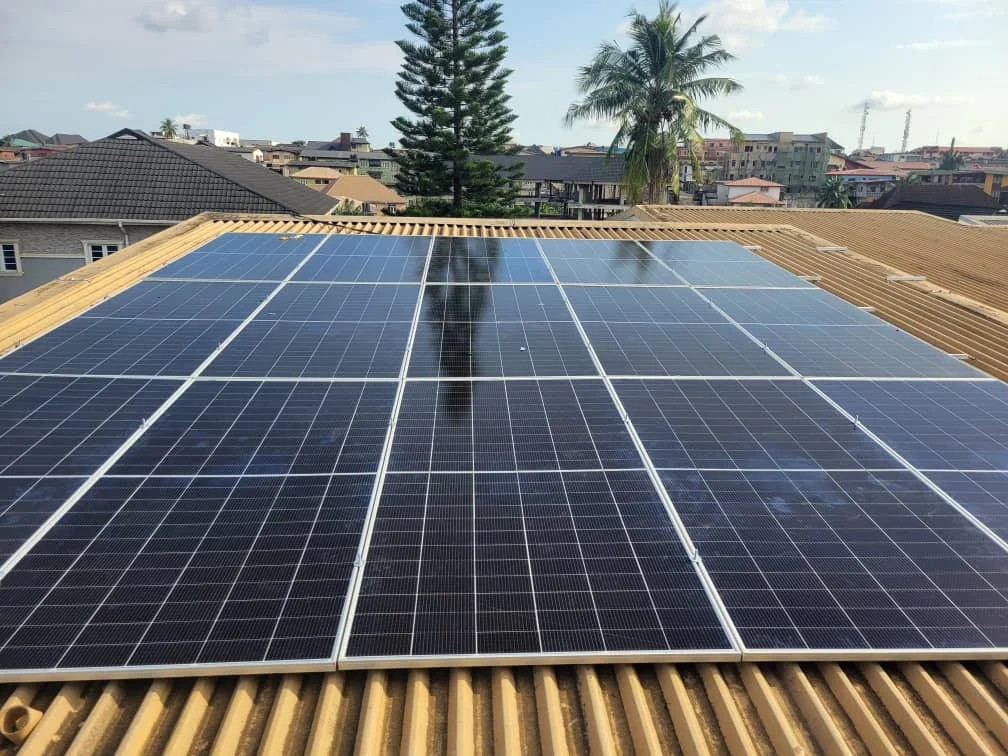
Panel wattage then decides how much roof a given kWp needs. At 620 W a module, a 6 kWp array is ten panels; at 400 W it is fifteen. On a constrained Lagos roof that difference is often what makes the target size reachable at all, which is why higher-output modules like the Jinko 620W bifacial have become the default specification.
Start with your loads, especially the ACs
In Lagos, air conditioners dominate the load. A 1.5HP inverter AC draws about 1.2 kW while it pulls the room down, then settles to roughly 0.5–0.9 kW; add fridges, freezers, water pumps, lighting, TVs and work equipment. Add up everything that might run at once and you have your inverter size. Add up what runs across the day and you have your panel and battery sizes.
Solar calculator
What system covers you, and what does it cost?
₦500,000 a month
₦100,000 a month
To take the generator off the job, the system that fits is
Solepower Home 18
₦16.8M
18.6 kWp solar · 18 kVA inverter · 30 kWh battery
You use about 42 kWh a day. The system costs the same as 28 months of what you spend on power now.
How we worked this out
- Every answer comes from Solepower Intelligence, our simulator. It runs a full year hour by hour on measured Lagos sunshine (1,397 kWh per kWp) and a measured Lekki grid year, with outage timing kept as recorded.
- From your bill it works out how much power you use, pricing grid at ₦210 a kWh and generator power at ₦1,900 a litre of diesel, weighted by when a home uses power and when the grid is actually up.
- It then tries each of our packages against that year and picks the cheapest one that keeps the generator switched off. Your bill is rounded up to the next step we simulated, so we never undersize.
- Bills only: generator repairs and diesel price rises are left out, and both make the “keep paying” line steeper. A site survey gives the exact figure.
Typical Lagos systems and what they carry
These are Solepower packages. The site survey fixes the final design from your measured load and roof; the table shows how the three numbers scale together:
| System | Best for | Installed price |
|---|---|---|
| 6.2 kVA · 3.7 kWp · 10 kWh | 1–2 bedroom flat or small shop in Lagos running one AC, on the tightest budget | ₦3.9M–₦5M |
| 6 kVA · 5 kWp · 15 kWh | 2–3 bedroom flat in Lagos running one AC at night, getting under 12 hours of grid supply a day | ₦5.3M–₦6.1M |
| 10 kVA · 9.9 kWp · 30 kWh | Large 3–4 bedroom home or small office with up to 8 staff in Lagos | ₦8.6M–₦10.9M |
| 11 kVA · 8.7 kWp · 30 kWh | 3–4 bedroom home or small office shopping for a 10 or 12kVA system on a budget | ₦6.9M–₦9.8M |
| 12 kVA · 11.2 kWp · 30 kWh | 4–5 bedroom home or office with 10–15 staff in Lagos, where 2–3 ACs run all day | ₦9.1M–₦11.5M |
| 18 kVA · 18.6 kWp · 30 kWh | Large 5-bedroom duplex or small three-phase building running 4 or more ACs | ₦13.6M–₦16.8M |
| 24 kVA · 24.8 kWp · 60 kWh | Office, clinic, pharmacy or restaurant currently running a 20kVA generator through the day | ₦19.2M–₦23M |
| 36 kVA · 37.2 kWp · 90 kWh | Office floor, school or larger restaurant on a three-phase supply, running a 30kVA generator | ₦26.9M–₦34.1M |
| 48 kVA · 48.4 kWp · 120 kWh | Hotel, supermarket or private hospital running a 40–50kVA generator for most of the day | ₦37.2M–₦44.8M |
| 60 kVA · 60.8 kWp · 150 kWh | Large school, mall unit or office building running a 50–60kVA generator | ₦47.5M–₦55.9M |
| 72 kVA · 73.2 kWp · 180 kWh | Large hotel, light manufacturing or estate common services on a three-phase supply | ₦57.8M–₦67M |
The full ladder, with specifications for each tier, is on the Packages page.
How a system performs
A typical day, and what it can carry
Large 3–4 bedroom home or small office with up to 8 staff in Lagos
- Straight from the panels: 12 kWh
- From the battery: 16 kWh
- Essentials only: Fridge, lights, fans, TV, Wi-Fi (about 1 kW)27 hrs
- 5 kW: 2 ACs, fridge and lights5.4 hrs
- 7.5 kW: 2 ACs, fridge, workstations and lights3.6 hrs
What it runs
- ACs: 2 units (1.5HP) together
- Fridges: 1 fridge and 1 upright freezer around the clock, or 2 fridges
- Water pump: 0.75HP borehole pump: yes, several runs a day
- Washing: Yes, 1–2 loads a day
Show the hourly numbers
| Hour | Solar (kW) | In use (kW) | Battery |
|---|---|---|---|
| 12am | 0 | 0.9 | 61% |
| 1am | 0 | 0.8 | 58% |
| 2am | 0 | 0.8 | 55% |
| 3am | 0 | 0.8 | 51% |
| 4am | 0 | 0.8 | 48% |
| 5am | 0 | 0.9 | 45% |
| 6am | 0 | 1.1 | 41% |
| 7am | 1.3 | 1.3 | 41% |
| 8am | 2.5 | 1 | 46% |
| 9am | 3.5 | 0.9 | 55% |
| 10am | 4.3 | 0.9 | 67% |
| 11am | 4.8 | 1 | 80% |
| 12pm | 5 | 1.1 | 94% |
| 1pm | 4.8 | 1.1 | 100% |
| 2pm | 4.3 | 1.1 | 100% |
| 3pm | 3.5 | 1.1 | 100% |
| 4pm | 2.5 | 1.3 | 100% |
| 5pm | 1.3 | 1.5 | 99% |
| 6pm | 0 | 1.7 | 93% |
| 7pm | 0 | 1.8 | 87% |
| 8pm | 0 | 1.8 | 80% |
| 9pm | 0 | 1.7 | 74% |
| 10pm | 0 | 1.5 | 68% |
| 11pm | 0 | 1.1 | 64% |
Illustrative, not a measurement. Solar output is this package's rated daily generation spread over a clear-day curve; use follows a typical home (evening peak) pattern at the daily use the package is designed for. Cloudy and harmattan days produce less. Backup hours at the two higher loads are the figures on the package page; the essentials row assumes about 1 kW.
Day vs night: why battery size matters most for homes
Panels only produce in daylight; the battery carries everything after sundown. A home with heavy evening and overnight use (lights, ACs in bedrooms, fridge) needs more kWh of battery. An office whose load is mostly 9–5 leans on the panels and can often run a smaller battery. We size the battery to your overnight essential load plus the number of hours of autonomy you want.
Don’t oversize “just in case”
It’s tempting to buy big for peace of mind, but every extra kWp and kWh is money spent. Right-sizing against a measured load, and using the remote monitoring every Solepower system includes to tune it, is far more cost-effective. Systems can also be specified to allow battery or panel expansion later, so it’s fine to start at today’s load.